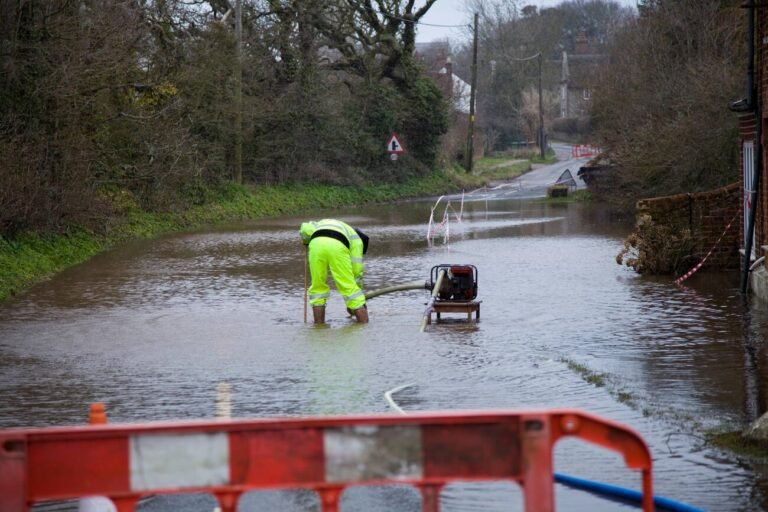
It is imperative to implement an immediate and effective reduction in emissions. Mainly, UK weather in 2026 is becoming significantly wetter. The burning of fossil fuels by humans is the cause of global warming. In addition to the warming, human activities release greenhouse gases into the atmosphere. In certain regions, winter rainfall across the UK has caused serious flooding.
Hundreds of homes, stretches of road, small businesses, and even some railway lines have taken a real beating. In several lowland farming counties, fields have stayed underwater for five weeks or longer now. Spring planting is at a standstill, winter cereals are rotting, livestock can’t get out to graze properly, and horticulture nurseries are struggling to lift or plant anything. Early signs are already showing up in the fields: lower yields look almost certain, and many people expect supermarket food prices to feel the pressure before long.
UK weather in 2026
UK weather in 2026, in some parts of the country, has been exceptionally wet. Several sites across the UK haven’t had an entirely dry day since 30 December. Winter rainfall across the UK has led to widespread saturation of the soil, triggering floods and disrupting normal life across various regions.
Provisional data indicates that January 2026 was particularly severe. Northern Ireland experienced its wettest January in 149 years, more rainfall than average. Southern England also recorded its sixth wettest January since the series began in 1836, with rainfall 74% above average.
Counties such as Cornwall and County Down set new records for the month, while others like Devon, Hampshire, and Surrey ranked second wettest. These facts indicate that UK weather in 2026 is unusual.
Winter rainfall across the UK
Regarding the UK weather in 2026, provisional Met Office data shows that some parts of the UK recorded more rainfall in the first five days than they would normally expect over the course of the whole month.
Aberdeenshire has been one of the wettest regions in the country. As of February 9, Aboyne has already experienced 376mm of rainfall. Which is nearly half of the anticipated annual rainfall (800mm) just six weeks into 2026.
Conversely, some areas of north-west England and western Scotland have been drier than normal, with Aultbea in the north-west Highlands recording no rainfall for 20 consecutive days.
Atmospheric Drivers Behind the Rain
The primary cause is a southward shift in the jet stream, steering Atlantic low-pressure systems toward the UK. During the early part of the season, North America experienced repeated outbreaks of freezing conditions. These significant temperature contrasts between cold Arctic air and warmer air to the south helped energise the jet stream, making it stronger and more active than usual.
A strengthened jet stream acts like a conveyor belt. It guides low-pressure systems across the Atlantic towards the UK. In the 2026 UK winter, the conveyor belt has been especially efficient. Storms that would normally weaken or divert instead travelled directly across the ocean. These storms brought successive bands of wind and rain.
Met Office presenter and meteorologist, Alex Deakin, said that a southerly shift in the jet stream, driven by the freezing conditions across North America, pushed low‑pressure systems further south than usual. Combined with a blocking pattern that caused these systems to stall, this set up a semi‑permanent south‑easterly flow into the UK weather in 2026.
Impacts on Daily Life and Economy
Heavy rain has caused a lot of flooding, and in early February, there were 107 flood warnings across the UK. Flood Duty Manager Andrew Hitchings said: “With another band of rain on its way, we need the public to remain vigilant to the risk of flooding.
“So far more than 16000 homes and business have been protected but sadly 300 have suffered flooding and our thoughts are with those communities affected.
“Our teams will continue to do all they can to support local people, with pumps, temporary barriers and by clearing waterways to ensure flood water can drain away.”
The transportation sector has been significantly impacted. In February 2014, storm-like conditions damaged southwest England’s Dawlish rail line. The onslaught of storms resulted in a sea wall collapse causing some disruption.
Relentless rain is jeopardizing farmers’ livelihoods
Flooding of surface water on roads made trips longer and more dangerous for drivers. Agriculture has suffered terrible effects. James Winslade, a farmer in Somerset, has observed that over 90% of his farm submerged in the recent rains. He is on the brink of losing his crops to rot.
“We can’t protect everywhere. There isn’t insurance for crop damage. We don’t get compensation.”
He said he is a third-generation farmer and that his father and grandfather never saw this level and recurrence of flooding.
Kevin Gilbert, the north east chairman of National Farmers’ Union of Scotland, said the “record levels of winter rainfall across the UK ” were having a serious impact on farmers.
“Any low-lying fields are completely submerged,” Gilbert – who farms near Kintore in Aberdeenshire – told BBC Scotland News.
“Farmers have to move their livestock to higher ground, and you can’t get ploughing done.
Gilbert said he had been farming for 35 years, and these were the worst conditions he had encountered. “It’s the extremes that are so difficult.”
The Country Land and Business Association (CLA), which represents more than 26,000 farmers and rural businesses, warned of mounting pressures.
According to Defra-commissioned research, winter floods cost farmers an average of £480/ha, with costs to arable and horticultural businesses two to four times higher.
How the effects of climate change exacerbate an already dire situation
The United Kingdom is experiencing a substantial increase in rainfall during the winter months. The rise in the rainfall can be due to global warming. The primary cause of global warming is the release of greenhouse gases into the atmosphere. The global warming phenomenon occurs due to the combustion of fossil fuels by humans.
Dr. James Carruthers at Newcastle University School of Engineering, , said: “The findings from our research show that climate change has already made our winters significantly wetter, with a 7% increase in rainfall per degree of global warming.
This is really concerning, as seasonal rainfall is increasing at a much faster rate than global climate models have predicted. We’re already experiencing changes in UK winter rainfall that global climate models predict for the 2040s – we’re 20 years ahead.”
“The UK Met Office data show that since the 1980s the UK climate has been warming at a rate of approximately 0.25°C per decade – so we’re seeing almost 9% more rainfall that we did in the 80s.
The UK government’s responsibility
Due to greenhouse gas emissions, there is an unusual rise in rainfall in the UK. Too much rainfall causes agricultural products to grow less, and this can result in an increase in food prices.
If the UK government do not take action to reduce greenhouse gas emissions, the situation will likely worsen in future. The UK government must seriously invest in flood-resilient infrastructure, better water resource management, and greenhouse gas emission reduction programs to reduce future risks.