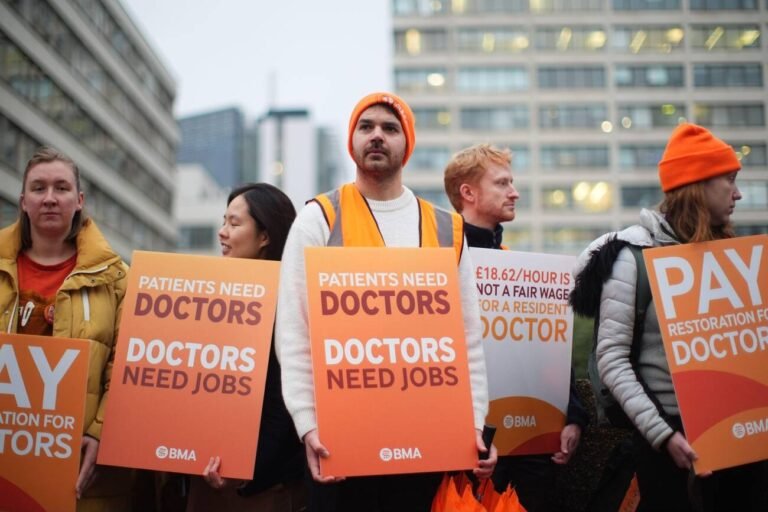
The doctors’ strike in 2026 is another round of strikes for a fair life. Resident doctors in England have voted to strike for another six months in their long-running dispute over jobs and pay with the Government. UK Junior Doctors have voted decisively to continue their fight for pay restoration. They need to resolve the employment crisis within the National Health Service.
The NHS is already under huge pressure this winter, with rising flu cases and other winter infections circulating. However, despite several strikes, the UK Junior Doctors still face a problem of payment and job security.
The Government announced pay rises for several public sector workers. The offer, however, does not include junior doctors, even though they need more money for their education.
Doctors’ strike in 2026: No More Employment Crisis
Resident doctors in England have voted decisively to continue their fight for pay restoration. They need to resolve the employment crisis within the National Health Service (NHS). The result of the re-ballot of 54,000 members of the British Medical Association (BMA) returned a 93 percent majority for strike action on a 53 percent turnout.
The doctors’ strike in 2026 led to hardship for the health secretary. The mandate to extend strike action until August 2026 shows the determination of resident doctors to defy Labour’s Health Secretary Wes Streeting.
Doctors’ strike in 2026: 14th Round of Strikes
In mid-December, resident doctors undertook their fourteenth round of strike action since March 2023. This was after they rejected a last-minute “offer” from Streeting. The BMA resident doctors’ committee (RDC) agreed to put it in place immediately before the walkout over five days. 83% of doctors rejected this offer as it failed to meet any of their basic demands. There was no change in the 5.4 percent award for 2025. It also left real pay erosion at 21 percent compared with 2008.
Streeting’s response to the jobs crisis was to expand the number of posts available by just 4,000. The response led to 20,000 doctors being locked out of specialty training last year. If resident doctors are to win, the fight must be taken out of the hands of the BMA officials.
UK Junior Doctors Must Fight Starmer: Efficiency Savings
After nearly three years of strike action, resident doctors (formerly known as junior doctors) are back on strike. However, there was a previous settlement between the BMA and Streeting in September 2024 to end their dispute.
The cause of resident doctors must be taken forward by ending their isolation. There is no resolution for the employment crisis without defeating the agenda of the Starmer government.
The agenda is imposing hundreds of millions of pounds of cuts packaged as “efficiency savings”. However, it demands greater productivity as it seeks to dismantle and privatize the NHS. Resident doctors make up half the medical staff in hospitals. They have insisted they are fighting for the NHS and patient safety.
However, this must be formulated in a strategy that rejects the whole “affordability” framework. This affordability framework was used to starve the public health service of funds and push it to the brink of collapse.
UK Junior Doctors: Six More Months of Strikes
Resident doctors in England have voted to strike for another six months in their long-running jobs and pay dispute with the Government. Their decision means that, unless an agreement emerges, the campaign of strikes by resident – formerly junior – doctors will enter its fourth year, as the industrial action began in March 2023.
Ministers cannot be shocked that 93% of doctors have voted to strike after being recommended a pay cut this year by the same health secretary who promised a journey to fair pay,” said Dr Jack Fletcher, the chair of the BMA’s resident doctors committee.
Without thousands more training posts, the bottlenecks in medical training will continue to rob brilliant young doctors of their careers. Doctors have clearly said today that is not acceptable. Fletcher said there should be a good deal.
A new job package and an offer raising pay fairly over several years can be effective through goodwill on both sides. It is also in the interests of patients, staff, and the whole NHS.
UK Junior Doctors Need Higher Pay Compared to Other Sectors
In May 2025, the Government announced pay rises for several public sector workers, including: 4.5% for members of the UK armed forces, with 3.75% for senior military staff; 4% for other doctors, dentists, and teachers in England, as well as prison officers in England and Wales; 3.6% for some NHS staff in England, including nurses and midwives
However, because a medical degree can take five or six years to complete – longer than most other degree courses – the BMA argues resident doctors’ pay should reflect the fact that they may have more student debt than other graduates.
Resident doctors also have little control over where and when they will work. They say that the need to make placements in different areas of the country can be expensive.
Health Minister Promises: The Government Must Prevent New Strikes
Health minister Wes Streeting, who criticized the repeated walkouts last year, vowed in December to do everything he could to prevent more disruption in 2026. The union has said doctors suffered years of real-terms pay erosion. Moreover, there will be thousands more training posts to break the deadlock.
“The government has nowhere to run and no means of running out the clock,” BMA chair Jack Fletcher said in a statement. “With no choice but to get a deal, we hope that means a responsible approach from the health secretary and a timely settlement with no further need for strikes.”
The BMA – which represents about 55,000 of the so-called resident doctors who make up nearly half of the medical workforce urged the Government to move quickly to prevent new strikes.
Government is Responsible for UK Junior Doctors’ Strike and Pressure on NHS
The doctors’ strike in 2026 is causing hardship for the NHS. The NHS is already under huge pressure this winter, with rising flu cases and other winter infections circulating. NHS chiefs have urged patients not to delay seeking care during the strike. That means attending scheduled appointments unless you have been contacted and told otherwise.
Prime Minister Sir Keir Starmer described the strike as “irresponsible” given the rising pressures on the NHS amid rising flu cases. However, the government must take measures to satisfy doctors and stop doctors’ strike in 2026; otherwise their burnout and dissatisfaction with current conditions will lead to a decline in healthcare services.
If an agreement is not reached this time, doctors will, for the fourth successive year, voice their demands to the government through strikes. The cure for England’s healthcare system lies not in hospitals, but in a decisive political decision to bring this four-year crisis to an end.