

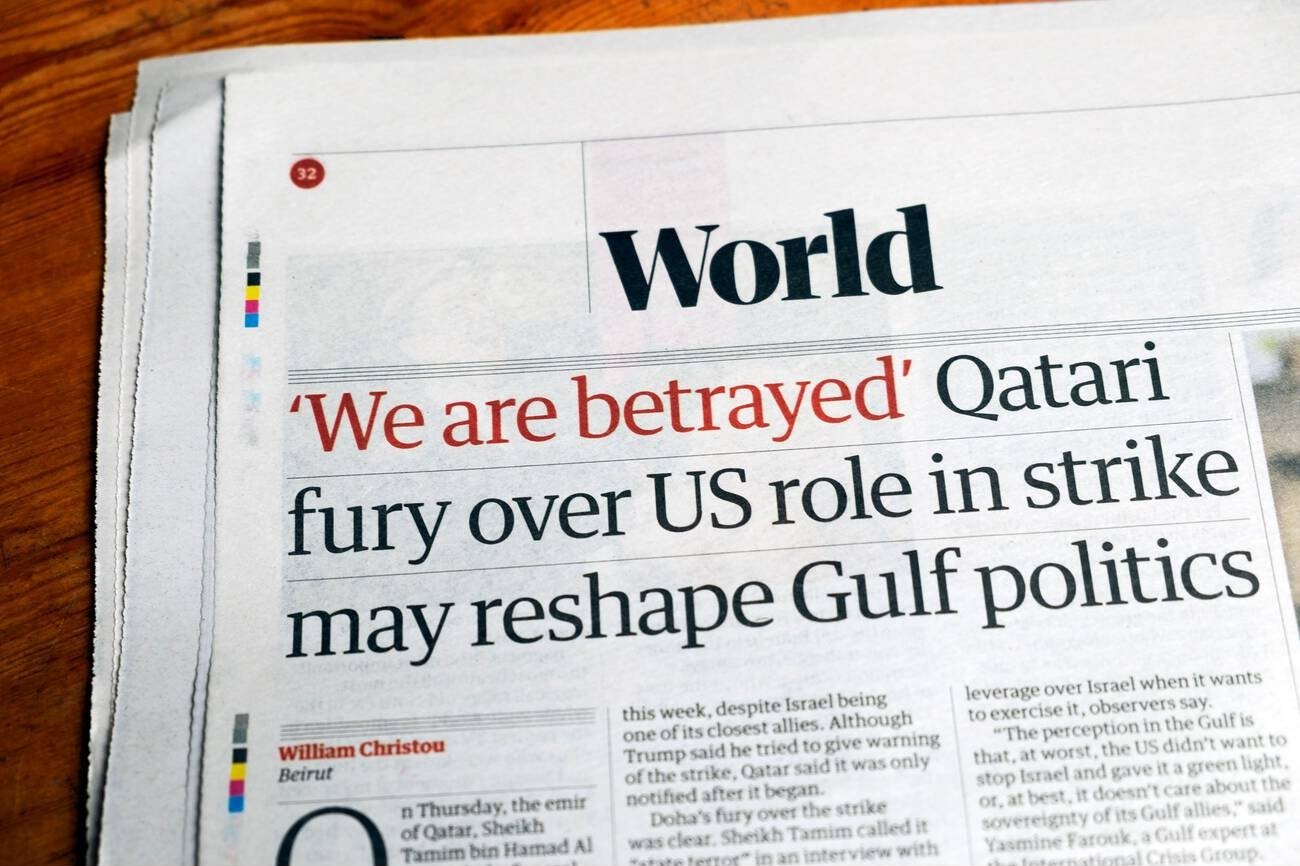
The international community must act to stop Israel’s violation of international law. The 9 September strike on negotiators in Doha marked a shocking breach of international human rights and humanitarian principles. Qatar vowed that Prime Minister Benjamin Netanyahu’s actions would not go unpunished. The Doha strike fits a well-established pattern of Israel breaking taboo after taboo. Israel is relentlessly pushing the boundaries of violence and destruction to normalise its policy of perpetual warfare. Israel’s violent policies are no longer limited to Palestine but are destabilising the wider region. This article examines Israel’s recent strike in Doha as a violation of international law, its impact on regional stability, and the global response.
Israel’s Violation of International Law: Israel’s Strike in Doha
Israel’s strike on negotiators in Doha on 9 September was a shocking breach of international law. It was an assault on regional peace and stability. This action, lacking humanitarian provisions, constitutes a blatant infringement of international humanitarian law. The attack violated the right to life under international human rights law and the principles of international humanitarian law.
Targeting parties engaged in internationally supported mediation on its territory undermines Qatar’s key role as a facilitator and peace broker. It is an attack on global efforts to resolve conflicts through peaceful means. In the case of the Israeli attack in Doha, the Hamas delegation was in Qatar to negotiate for a ceasefire.
Breach of International Humanitarian Law: Israel’s Assault in Gaza
On the same day as the attack, Israel signalled a new phase of its assault on Gaza. The latest phase included a displacement order for some one million people to leave Gaza City. However, there is no necessary provision for their safety and security. This attack is another blatant contravention of international humanitarian law.
Meanwhile, during the funerals for those killed in Doha, the Israeli Government formally signed off on the so-called E1 project near East Jerusalem. The Prime Minister described this project as fulfilling the Government’s promise to stop the creation of a Palestinian State.
Israel’s Violation of International Law: Qatar will Punish Israel
Qatar vowed that Benjamin Netanyahu’s violations of international law will not go unpunished. Netanyahu said that last week’s Israeli strike killed five Hamas members in Doha. He said it was a message claiming that the attack had been successful. Qatari Foreign Ministry spokesman Majed al-Ansari stated that the Israeli Prime Minister consistently attempts to deflect and justify his failures. He said that their message to Israel is that Israel’s violation of international law will not go unpunished.
Karim Emile Bitar is a professor of international relations at Saint Joseph University of Beirut. He said that the attack on Qatar would most likely lead to a hardening of attitudes towards Israel in the Gulf, rather than elsewhere. Qatari Prime Minister Sheikh Mohammed bin Abdulrahman bin Jassim Al Thani has said that Gulf states were discussing a response to Israel.
Israel’s Disregard for International Law: Attacking the Gulf Countries
Qatar is a major US non-NATO ally that hosts some 11,000 US military personnel. Israel’s unprecedented airstrike on Qatar is a significant escalation of its military operations. The attack also threatens to destabilise the Middle East further. The bombing of Doha is the most recent of a string of bombings that reveal the increasingly brazen actions of a rogue state, Israel. Qatar is added to an increasing list of countries, including Palestine, Iran, Lebanon, Syria, Tunisia, and Yemen. Israel has targeted these countries with military strikes in blatant disregard of national sovereignty and international law. The Doha strike fits a well-established pattern of Israel breaking taboo after taboo. It shows Israel is relentlessly pushing the boundaries of violence and destruction to normalise its policy of perpetual warfare.
Israel’s actions confirm its complete disregard for international law. It wants to further escalate its unchecked belligerence against sovereign states across the region, with no regard to red lines. Netanyahu has benefited from unwavering US support and impunity for his actions in Gaza. The question now is whether the international community will finally use its diplomatic and legal leverage to hold Israel accountable for its crimes against Palestinians and the region.
World Leaders Criticise: No one stops Israel.
World leaders were quick to criticise Israel for its attack in Qatar on Tuesday, targeting Hamas political leaders discussing a ceasefire in Gaza. But the rhetorical condemnation of Israel’s attack may not translate into meaningful policy shifts. Israel has continually ignored international law during its war on Gaza, where it has killed more than 64,000 Palestinians, destroyed the enclave, and caused a famine. It has also repeatedly attacked neighbouring countries and rejected any international criticism it has faced.
But action against Israel from Western countries is still minimal in comparison with the isolation and sanctions placed on Russia following its invasion of Ukraine. That is despite Israel becoming increasingly unrestrained in committing violence across the Middle East. Neither has Israel indicated that it regrets the attack upon Qatar, nor given other states reason to hope that their territory would not be host to similar attacks. Therefore, Israel’s violation of international law requires serious actions by different countries.
EU Suspends Trading Association Agreement with Israel
A notable exception has come from the European Union. Following President Ursula von der Leyen’s State of the Union address, the European Commission proposed suspending key trade-related provisions of the EU–Israel Association Agreement.
The suspension concerns the core trade-related provisions of the Agreement, and in practice means that imports from Israel will lose their preferential access to the EU market. These goods will therefore be subject to duties at the same level as those of any other third country with which the EU has no free trade agreement.
The proposals follow a review of Israel’s compliance with Article 2 of the Agreement. Article 2 shows that Israeli Government actions represent a breach of essential elements for human rights and democratic principles. This sanction entitles the EU to unilaterally suspend the Agreement. Specifically, this breach refers to the rapidly deteriorating humanitarian situation in Gaza following the military intervention of Israel, the blockade of humanitarian aid, the intensification of military operations, and the decision of the Israeli authorities to advance the settlement plan in the so-called E1 area of the West Bank, which further undermines the two-state solution.
UN and Turkey Condemned Israel: More Destabilisation in the Region
UN rights chief condemns Israeli strike on Qatar as ‘shocking breach of international law. The EU also expresses full solidarity with Qatar. Doha is a strategic partner that plays a crucial role as a mediator of the conflict in Gaza. As a result, Israel’s violation of international law is threatening the peace in the world.
Burak Akcapar is Turkey’s permanent representative to the UN in Geneva. He reiterated Ankara’s ‘faithful unity with Qatar during. The Turkish agent said Israel’s violent policies are no longer limited to Palestine. Israel is trying to destabilise the wider region. He pointed to countries like Lebanon, Syria, Iran, Yemen, Tunisia, and, most recently, Qatar, a mediator state.
The Urgent Need for Accountability
Israel’s repeated breaches, including striking neutral states, displacing civilian populations, and expanding illegal settlements, reflect a systematic violation of international law. The attack on Doha highlights the dangers of allowing impunity to persist: diplomatic processes are undermined, regional stability erodes, and the authority of international law is weakened.
For the Middle East to avoid further destabilisation, the international community must move beyond statements of condemnation. Diplomatic, economic, and legal mechanisms are available to hold Israel accountable. Whether global leaders will act decisively remains the pressing question.
