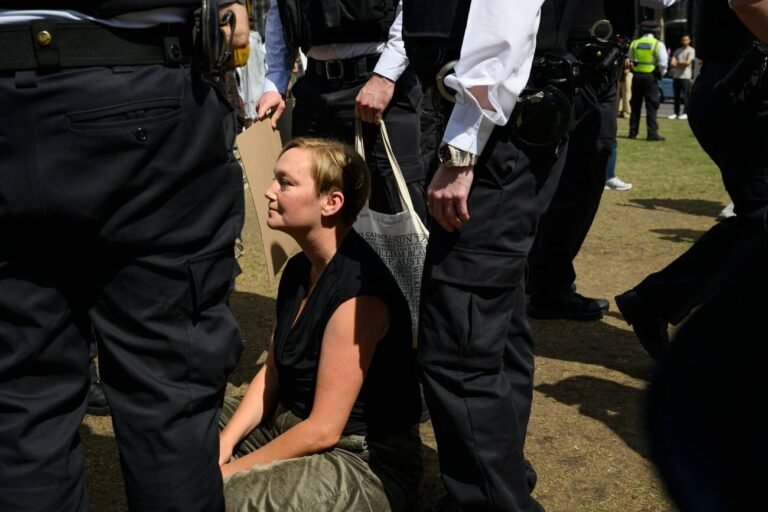
The British Prime Minister recently announced that he supports pro-Palestine protests ban in the UK by taking more power. Some experts say that such a move contradicts freedom of speech and freedom of peaceful assembly in the UK. The ban weakens democracy in the UK and contradicts British values. The British government silences the voices of the people defending the people of Gaza.
Freedom of Speech Vs. Cracking Down on Pro-Palestine Activism
In the UK, Article 10 of the Human Rights Act protects the right to freedom of expression. Every individual has the freedom to express themselves. This right entails the freedom to hold opinions and the freedom to receive and exchange ideas and information without interference from any governmental body.
Pro-Palestine protests ban in the UK opposes the right to free speech. However, British authorities have repeatedly faced criticism for cracking down on pro-Palestine activism during Israel’s genocidal war on Gaza. Last month, British police arrested more than 500 people during a mass vigil in central London. They had gathered to oppose the ban on the campaign group Palestine Action.
Starmer and Pro-Palestine Protests Ban in the UK
British Prime Minister Keir Starmer said the government could ban pro-Palestinian marches in some circumstances. It is because of the “cumulative effect” the demonstrations had on the Jewish community after someone stabbed two Jewish men in London. His comments come days after a series of attacks on the British Jewish community in recent weeks. Specifically, these attacks included the stabbing of two Jewish men in Golders Green in north London on Wednesday, 29 April 2026. However, both men have now been discharged from the hospital.
Starmer told the BBC that he would always defend freedom of expression and peaceful protest. However, chants like “Globalize the Intifada” during demonstrations were “completely off limits”. Therefore, those voicing them should be prosecuted. Starmer said he was not denying there were “very strong legitimate views about the Middle East, about Gaza. However, many people in the Jewish community had told him they were concerned about the repeat nature of the marches.
Pro-Palestinian Marches: Government’s Tougher Responses
Pro-Palestinian marches are common in London. It started with the October 2023 attack by Hamas on Israel that triggered the Gaza war. Critics say the demonstrations have generated hostility and become a focus for antisemitism. Protesters have argued they are exercising their democratic right to spotlight ongoing human rights and political issues related to the situation in Gaza.
Asked if the tougher response should focus on chants and banners, or whether the protests should be stopped altogether, Starmer said: “I think certainly the first. I think there are instances of the latter. Moreover, I think it’s time to look across the board at protests and the cumulative effect.” He added that the government needed to look at what further powers it could take.
Government Against Activist Groups: Pro-Palestine Protests Ban in the UK
Britain’s terrorism watchdog on Wednesday, 29 April 2026, said the government risked stretching counterterrorism laws beyond their original purpose by using such powers against activist groups. It blurred the line between protests and national security threats.
In his annual report examining the use of Britain’s terrorism legislation during 2024, independent reviewer Jonathan Hall said the subsequent banning of pro-Palestine group Palestine Action had exposed “real uncertainty” over whether serious damage to property alone should qualify as terrorism. The law’s broad wording could, without a clearer limit, risk pulling protest activity into terrorism policing. However, it happens even where there is no intent to harm people, Hall said. “There is no legal authority on what ‘serious damage to property’ means,” Hall wrote. He says the definition could extend beyond violent attacks to acts such as criminal damage, depending on how courts interpret the threshold.
Pro-Palestine Protests Ban in the UK: Unlawful Action
Hall’s report comes as the government appeals a High Court ruling that found the banning of Palestine Action unlawful on the grounds of free speech. Meanwhile, the ban, imposed in July 2025, remains in force pending the outcome of the appeal.
UN Human Rights Chief Volker Turk warned at the time that using counterterrorism legislation to implement the ban on Palestine Action risked “hindering the legitimate exercise of fundamental freedoms across the UK”. Hall’s report also highlighted growing reliance on counterterrorism laws to police online propaganda and political expression.
Cutting the Root of Free Speech: Banning Protests
PM says there are instances in which he would support bans, but organizers say this would ‘strike at the root of free speech’. However, organizers of pro-Palestine marches have said Keir Starmer’s threat to ban some demonstrations opposing Israel’s actions in the Middle East will “strike at the root of free assembly and free speech” in the UK. John Rees is co-founder and national officer for the Stop the War coalition. The coalition helps organize large pro-Palestine demonstrations in central London. John Rees considered Starmer’s comments a “threat” against his coalition’s own protests.
Starmer said he also wanted to apply “tougher action” to the language of chants, including the chant “globalize the intifada”. Intifada is an Arabic word that translates to uprising or “shaking off”. Some pro-Palestine voices use the phrase as an expression of solidarity with Palestinians resisting Israeli occupation. At the same time, some Jewish groups and leaders have described it as a call to violence. Starmer called the chant “globalize the Intifada” a case of “extreme racism”. He said there would be prosecution for those who use it.
Globalize the Intifada: An Excuse to Ban Pro-Palestine Protests
The pro-Palestine protests ban in the UK comes after government dissatisfaction with a chanted phrase. When asked about a “small percentage” of people who appear to express support for Hamas or chant the phrase “globalize the intifada”, Rees said out of the millions of people who have attended the demonstrations overall, a “minuscule number” of arrests have been made for such offenses.
Rees said the problem with linking pro-Palestine demonstrations with attacks on Jewish people is that it “acts as if there’s a causal relationship” between the two. Rees referred to those who carry out attacks against the Jewish community. He included Essa Suleiman, who has been charged with three counts of attempted murder after attacking a longtime friend. It happened before stabbing two Jewish men in Golders Green. Rees said these kinds of individuals do not connect to the Palestine movement and the marches. There’s no evidence that they’ve ever seen a march, let alone been on one.”
Jewish People Attending Pro-Palestine Protests
Rees said there is no threat whatsoever to the Jewish community from these marches. In fact, thousands of Jewish people attend and disapprove of the actions of the government. They disapprove of the actions of the State of Israel. Defend Our Juries organizes demonstrations where people express support for the proscribed group Palestine Action. It responded to Starmer’s comments on X, saying: “End the genocide, not our freedoms to oppose it.”
Instead of putting pressure on Israel to stop its crimes and instead of cutting off arms sales to Israel, the British government is suppressing domestic protesters. This action weakens democracy in Britain and contradicts British values. Therefore, The British government should recognise the right to protest against Israeli genocide in Gaza.